
Journal 5 Finding My Rhythm, Then Saying Goodbye
Our final Consent Café took place at Khalsa College in Amritsar. My group consisted of two young adult women and one very determined seven-year-old girl. The young women were eager, engaged, and ready to participate in every activity. The little girl was equally enthusiastic, although I am not sure how much of the material she truly understood. She sweetly asked us to take her picture so she could send it to her mother. She was attending with her auntie because her mother was preparing to have another baby.
Having such a wide range of ages in one group made me think about developmental appropriateness in social work education. Although the little girl enjoyed being included, participation does not necessarily mean understanding. Consent education needs to be adapted to a person’s age, language, experience, and level of comprehension. It reminded me that social workers cannot simply deliver the same information to everyone and assume it has been understood. We must pay attention to verbal and nonverbal responses, adjust our approach, and meet people where they are.
The activities were genuinely appreciated, and somewhere along the way I realized that I had finally found my rhythm. I was no longer questioning every word or worrying about what I should do next. I could read the group, adjust when needed, and trust myself as a facilitator. That confidence did not come from suddenly having all the answers. It came from listening, observing, remaining flexible, and allowing each group to help shape the conversation.
Of course, just as I began to feel comfortable, the cafés were over. I felt proud of my growth but also sad that this part of the trip had ended. The experience strengthened my understanding that effective social work is relational. The activities mattered, but the relationships, trust, and sense of safety created around them mattered just as much.
After class, the sky suddenly opened, and rain poured down over the college. It was not a gentle shower but a proper downpour that arrived with little warning. By the time we began the drive to the Golden Temple, the rain had stopped. Instead of cooling the day, it left the air hot, heavy, and incredibly humid. The heat clung to us, making the walking even more physically demanding.
Even so, nothing quite prepares you for seeing the Golden Temple for the first time. It seemed to glow against the water a place that felt both grand and peaceful despite the crowds moving around us. Being there reminded me that spirituality, culture, identity, and community can be deeply connected. In social work, these parts of a person’s life cannot be separated from their overall well-being.
Unfortunately, our visit was cut short because of a mix-up. I also felt terrible when a guard physically pushed one of my classmates. I understood that we were visitors navigating unfamiliar customs, expectations, and crowded surroundings, but cultural humility does not require ignoring harm or pretending that something upsetting did not happen. Social work asks us to hold complexity: to respect cultural differences while also remaining aware of power, safety, and human dignity. I could recognize that I did not fully understand the situation while still acknowledging the impact it had on my classmate and myself. In no way should anyone have laid their hands on another
As we walked back to the van, we moved through the markets and took in the colours, sounds, people, and activity of Amritsar. Even the disappointing end to our visit could not erase how remarkable it had been to see the Golden Temple.
Then came party day and these ladies know how to party.
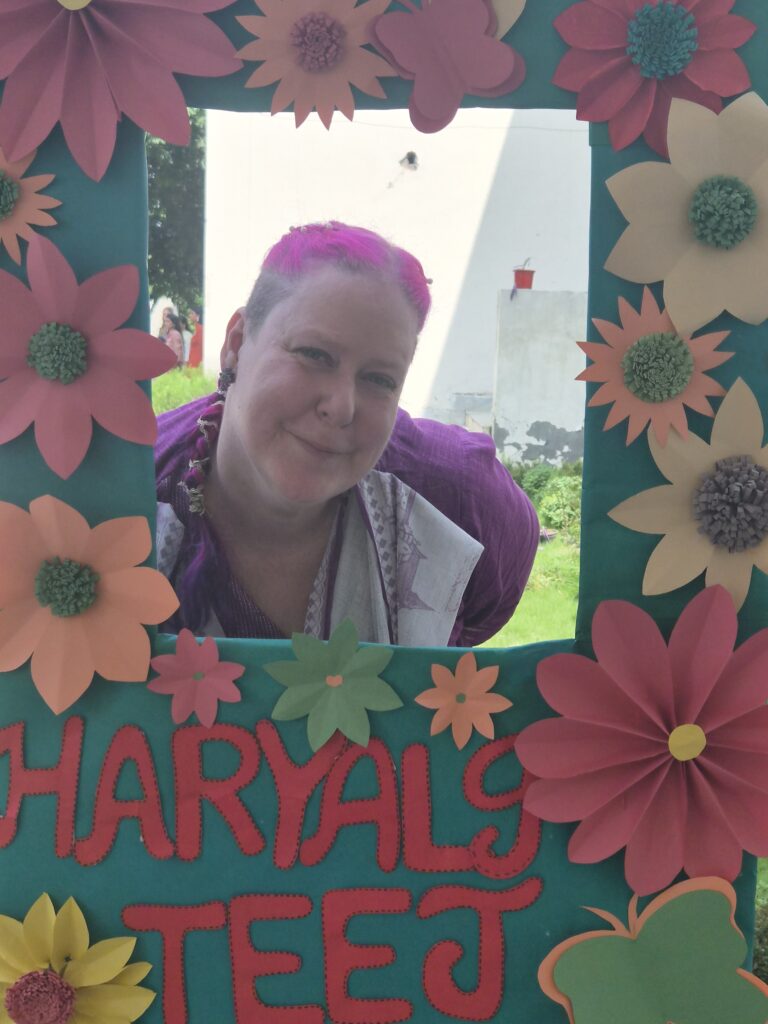
I had my hair done, put on my traditional outfit, and absolutely loved how I felt in it. Even better, it was surprisingly comfortable. The celebration was for TeeJ or Teeyan, as it is known in Punjab. Teeyan is a Punjabi monsoon festival centred on women, particularly daughters, sisters, and mothers gathering together. It is traditionally celebrated through colourful clothing, music, singing, dancing, swings, sweets, and reconnecting with family and community. Women may perform giddha, a traditional Punjabi folk dance, accompanied by lively songs known as boliyan.
In some ways, the gathering reminded me of an Indigenous powwow not because the cultures or ceremonies are interchangeable, but because of the feeling of community surrounding them. I recognized a similar sense of cultural pride, traditional clothing, music, dancing, celebration, and different generations gathering together. Both can create spaces where culture is not merely described but actively lived, shared, and carried forward.
This connection also made me reflect on the importance of cultural identity as a source of strength. Social work often focuses on people’s problems and needs, but a strengths-based perspective also asks us to recognize culture, family, ceremony, belonging, and collective joy as resources that support resilience and well-being. At Teej, I was not simply watching a celebration. I was witnessing women creating and maintaining connection through shared traditions.
There was music, dancing, laughter, and what appeared to be a pageant. Eventually, one young woman was awarded Miss Teej. I may not have understood every part of what was happening, but I did not need an explanation to recognize the energy in the room. After so many serious conversations and emotionally demanding moments during the trip, it felt wonderful to dress up, celebrate, and be surrounded by women enjoying themselves. Joy and celebration also have a place in social work; people and communities are more than their struggles.
The night was supposed to continue with a girls’ night, but I chose to pass and rest. Earlier in the trip, fear of missing out might have pushed me to go, regardless of how exhausted I felt. This time, I listened to what my body and mind needed. Social workers frequently speaks about self-care, but this trip reminded me that it must be more than something we recommend to other people. Recognizing my limits and choosing rest were ways of practising the same care, dignity, and compassion that I hope to offer others.
My final Consent Café ended just as I discovered my confidence, and the experience concluded in a swirl of beautiful clothing, music, dancing, and colour. It felt bittersweet: one last lesson, one last celebration, and one more reminder that social work learning does not happen only in classrooms. It happens through relationships, discomfort, cultural exchange, careful reflection, and the willingness to keep learning from the people and communities around us.