
This journal is going to be a little different, but I still wanted to reflect on the experience through a social work perspective.
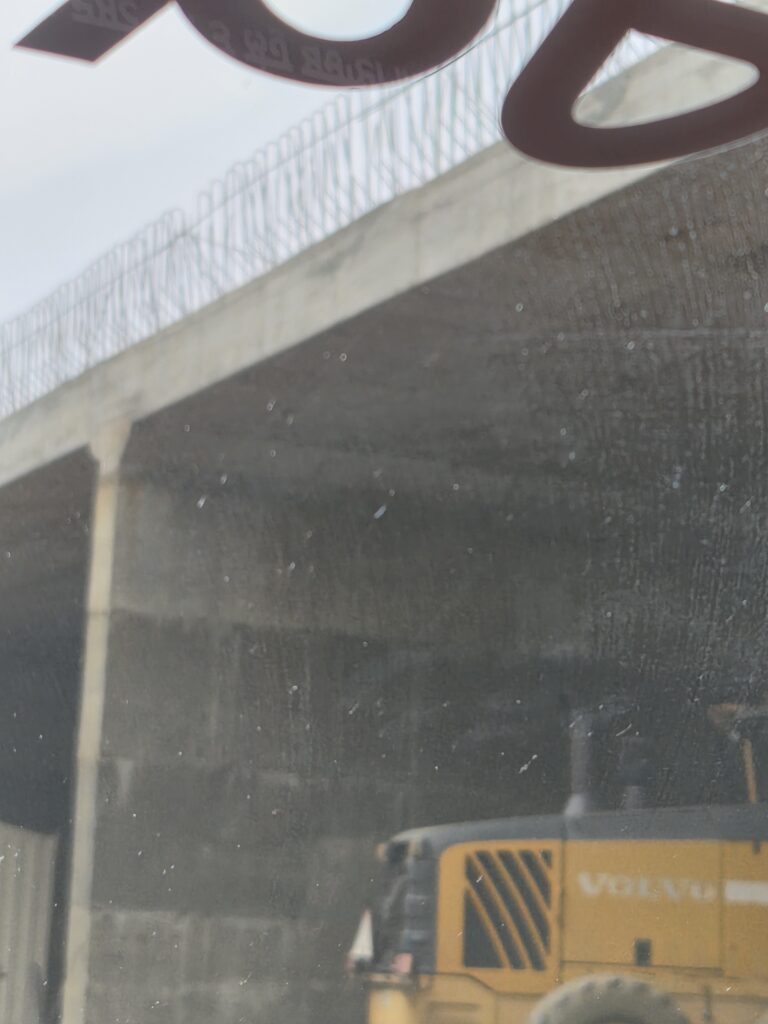
As a former construction worker, seeing how construction appeared to be done in India was very eye-opening. My instructors were extremely clear that I was not to enter any active construction sites. I understood and respected that boundary, even though I sometimes had to fight the urge to take a closer look.
Everything I observed was from outside the sites, so I recognize that I did not see every safety measure or understand the full context. Still, many of the practices looked very different from what I had been taught and experienced in Canada. Some scaffolding reminded me more of the latticework we use to support plants than the metal scaffolding I was accustomed to seeing. I watched men paving roads while wearing flip-flops, without the protective footwear I would expect on a Canadian worksite. Even the plumbing grades I could see concerned me. Some appeared so slight that water might collect, while others seemed steep enough to create pressure problems such as water hammer.
After doing some research, I learned that India does have construction and workplace-safety standards. The Building and Other Construction Workers Act was passed in 1996, followed by the Central Rules in 1998. India also has the National Building Code of 2016, and the Occupational Safety, Health and Working Conditions Code was passed in 2020. These standards address areas such as scaffolding, protective equipment, building safety and working conditions. However, what exists in policy and what I personally observed on the ground did not always appear to match.
This reminded me of an important lesson in social work: creating a policy does not automatically make people safe. Policies must also be consistently implemented, enforced and made accessible. Workers may have limited power to refuse unsafe conditions, particularly when employment is insecure and supporting their families depends upon accepting the work available. From the outside, it would be easy for me to judge what I saw according to Canadian standards. A social work perspective asks me to look further and consider the economic inequality, labour conditions and power imbalances that may influence the choices available to workers. At the same time, cultural humility does not mean ignoring genuine concerns about safety or worker dignity.
My concerns about construction became unexpectedly personal on my second-to-last night in India. A powerful thunderstorm (monsoon?) was raging outside, and when I got out of bed, I discovered that I was standing in water. Rain was leaking through the windows and spreading across my room’s floor. I had noticed a small amount of water before, but this time much of the floor was covered.
My old construction instincts immediately took over. I wanted to begin pulling things apart and figuring out exactly where the water was coming from. Instead, I reminded myself that this was not my building, I did not have permission to investigate, and I needed to ask for help. I ran downstairs in my pyjamas and bonnet and tried to explain the problem to a man who did not speak English. Somehow, despite the language barrier, we communicated well enough for staff to understand. They came upstairs and squeegeed the water from my room.
Only one of my bags became wet, and thankfully it was waterproof, so only the outside was affected. I was frustrated by the situation, but I was also grateful that my belongings were safe and that the staff responded.
The experience reminded me how vulnerable it can feel to need help when language and cultural differences make communication difficult. It also reinforced the importance of remaining calm, adapting how we communicate and trusting that understanding can be reached without shared words. These are skills that connect directly to social work, especially when supporting people who may feel overwhelmed, displaced or unable to explain what they need.
The drive to Delhi was uneventful, as was getting onto the plane. After the flooded room and the raging storm, an uneventful journey home felt like a welcome ending.
India challenged both the construction worker and the social worker in me. I returned home thinking not only about the physical structures I had seen, but also about the social structures surrounding them. Safety is not simply a matter of having rules written down. It is also about enforcement, resources, working conditions, power and whether people genuinely have the ability to protect themselves.