
Final Reflection: What I Am Bringing Home
Looking back over my first six journal entries, I can see that this experience taught me far more than I understood while I was living it. At the time, I was focused on getting through each day, adjusting to constant changes, managing my health, participating in the Consent Cafés, and trying to take in everything happening around me. Now that I am home, I can step back and see how these experiences connect to social work and how much they taught me about culture, power, grief, relationships, self-determination, and myself.
The learning began before we even arrived. Cancelled flights, unexpected accommodations, payment problems, rain, unfamiliar surroundings, and plans that changed without warning required me to adapt quickly. I learned that preparation is valuable, but flexibility is equally important. This is also true in social work. We may enter a situation with knowledge, resources, and a plan, but people’s lives do not unfold according to our plans. Ethical practice requires us to respond to what is actually happening rather than forcing people or situations to fit our expectations.
Some of the most meaningful moments were also the least planned. Watching schoolgirls dance in the rain outside the Lotus Temple reminded me that joy can exist even when circumstances are uncomfortable or uncertain. At the Gugan Family Farm and the Taj Mahal, I experienced beauty and grief at the same time. These moments taught me to hold more than one truth at once. A person can be grieving and still experience happiness. Someone can be struggling and still demonstrate strength. Social work often requires us to make room for these complexities rather than viewing people only through their pain, challenges, or needs.
The Consent Cafés were central to my learning. As we moved through the different groups, I became more confident and developed a rhythm in facilitating the activities. At the same time, I learned that the same approach does not work for everyone. We needed to adjust our language, activities, and expectations based on the people in front of us. This reflected person-centred practice because the purpose was not simply to deliver information. It was to create a space where the young women could participate, ask questions, share their understanding, and connect the ideas to their own lives.
The cafés also deepened my understanding of the relationship between consent and power. I noticed that the young women sometimes behaved differently when teachers or other authority figures entered the space. This reminded me that knowing you have the right to say no is not the same as feeling safe enough to exercise that right. Age, gender, family expectations, religion, education, social position, and authority can all affect a person’s ability to make and communicate choices.
From a social work perspective, consent must involve more than teaching someone the correct words. It requires attention to the social and structural conditions surrounding that person. Self-determination is difficult to exercise when saying no may result in punishment, rejection, shame, or danger. This experience showed me why social workers must consider both the individual and the environment rather than locating every problem within the person.
One of the comments that affected me most came after the planned activities, pictures, and feedback were already finished. One young woman quietly said, “Even God asks for consent.” Her words stayed with me because they showed that learning does not always happen in a way we can immediately measure. Sometimes the most meaningful response comes later, almost as an afterthought. It also reminded me that people interpret new ideas through their own cultural, spiritual, and personal understanding. My role was not to tell her what consent had to mean within her beliefs. It was to offer information and create enough safety for her to make her own connection.
This trip also made me think more deeply about cultural humility. I arrived in India carrying my Canadian values, experiences, education, and assumptions. I noticed differences in construction, safety standards, gender roles, education, personal boundaries, and everyday life. Some things concerned me, while others made me recognize how quickly I can compare another country to what I know at home.
Cultural humility does not mean ignoring concerns or deciding that every practice is acceptable simply because it is cultural. It means being reflexive about my own position and recognizing that I am viewing another society through my own tinted lens. It asks me to listen before judging, remain curious, and understand that I do not become an expert on a culture because I spent a short time within it. This is an important part of anti-oppressive social work practice. Good intentions do not remove the power I carry as a Canadian visitor, student, and future social worker.
I also became more aware of how policy and lived reality can be very different. Rules, rights, codes, and services may exist on paper, but that does not automatically mean they are accessible, enforced, or experienced equally by everyone. This applies in India, but it also applies in Canada. Social workers must look beyond what a system claims to provide and ask how that system is actually experienced by the people expected to use it. We need to notice who is protected, who is excluded, whose knowledge is valued, and who is expected to adapt.
Communication was another major lesson. Language barriers sometimes made interactions more difficult, but connection still happened through gestures, expressions, laughter, dancing, cricket, Punjabi words, shared activities, bracelets, photographs, and simply spending time together. These experiences reminded me that communication is not limited to speaking the same language. It begins with presence, attention, patience, and a willingness to understand.
I also learned that relationship-building must include boundaries. The young women’s requests to connect through Instagram seemed friendly and innocent, but they raised questions about privacy, professional roles, and how relationships should continue after we left. Social work asks us to be genuine while also maintaining boundaries that protect everyone involved. A boundary does not mean that a connection was not real. It means thinking carefully about power, responsibility, and the possible long-term effects of our choices.
The trip taught me as much about myself as it did about social work. I am truly happy that I went, and I would not trade the experience. However, I now understand more clearly how my personality and personal limitations affect the way I function. I am an ambivert, and I require quiet and time alone to process my thoughts and restore my energy. Constant social interaction, noise, heat, travel, uncertainty, and a lack of personal space in public gradually reduced my emotional and physical capacity.
Understanding this is not the same as saying I cannot do difficult things. I completed the trip and participated in experiences that pushed me well beyond my comfort zone. The lesson is that I need to recognize my limits earlier and plan for them instead of waiting until my body or mind forces me to stop. This is part of developing my professional use of self. In social work, I will bring my personality, history, strengths, vulnerabilities, and emotional responses into every relationship. Reflexive practice means being aware of these parts of myself, so they do not unintentionally affect the people I support.
Becoming ill and experiencing pain also triggered trauma that I believed I had resolved. It reminded me that trauma is not always gone simply because we have learned how to function around it. Physical vulnerability, loss of control, or an unfamiliar environment can bring old experiences back unexpectedly. This gave me a more personal understanding of trauma-informed practice. Trauma may appear through emotions, physical reactions, withdrawal, fear, anger, or a need for control. We cannot assume we know what is happening inside another person based only on what we see.
Missing planned activities, including the shopping day, brought guilt and fear of missing out. Part of me felt that I should push through because the trip was temporary and I might never have the same opportunity again. However, self-care meant accepting that continuing could make things worse. I learned again that self-care is not always enjoyable or comforting. Sometimes it means making a disappointing choice because it is the responsible one.
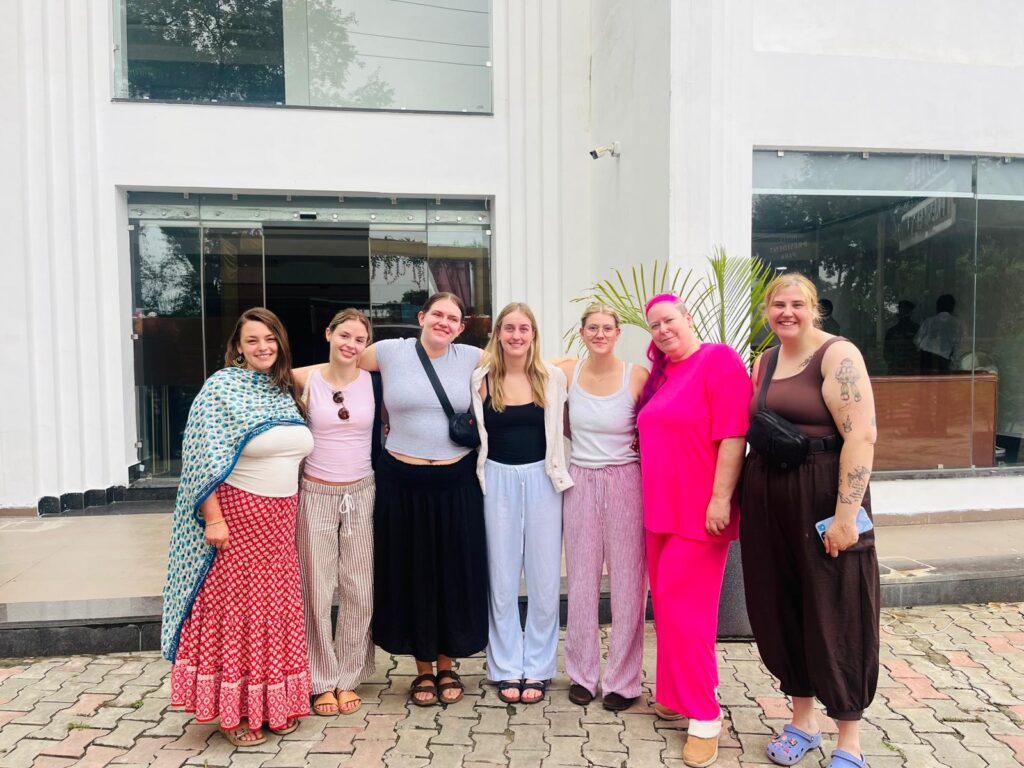
I was also reminded that self-care is not only an individual responsibility. My team supported me with kindness and grace, never making me feel like a burden. Their response demonstrated community care in action. Social work often encourages people to ask for help, yet helpers can struggle to accept support themselves. I had to allow others to care for me and trust that needing assistance did not make me less capable or less deserving of being there. Interdependence is not failure. People survive and grow through relationships.
Grief was present throughout the entire journey. Matt was supposed to be there. We were supposed to experience India together and then spend another week travelling. His death less than two weeks before leaving changed the meaning of the trip before it even began. I carried Uni, his picture, our plans, and the awareness of his absence into every new place.
There were moments when I felt Matt’s absence sharply, but there were also moments when I felt his spirit near. Beauty, laughter, unusual sights, long drives, and unexpected adventures made me think about what he would have said or done. In India, grief travelled alongside movement. Every day offered somewhere new to go, something to learn, or a problem to solve. The schedule gave my grief somewhere to move, even though it never disappeared.
Once I returned home, grief felt different. The movement stopped. There were no new cities, cafés, temples, classrooms, or activities demanding my attention. Home was familiar, but Matt’s absence within that familiarity made the loss feel more permanent. In India, I grieved the journey we were supposed to share. At home, I began grieving the ordinary future the conversations, visits, laughter, and everyday moments that will never happen.
This helped me understand grief as a changing and non-linear process. Returning home did not mean returning to the person I was before I left. Grief can exist quietly in the background and then become overwhelming when life slows down. It can coexist with gratitude, laughter, learning, and pride. Feeling joy during the trip did not mean I missed Matt less, just as feeling the loss more strongly at home does not erase the happiness I experienced in India.
This is also an important social work lesson. We cannot place a timeline on another person’s grief or assume that the hardest period will occur immediately after a death. Context matters. Responsibilities, travel, family, culture, support systems, and moments of quiet can all affect when and how grief is felt. Supporting someone who is grieving requires patience and a willingness to sit with emotions that cannot be fixed.
When I bring all these experiences together, I recognize that India taught me about more than international social work. It taught me about cultural humility, consent, power, structural inequality, self-determination, communication, professional boundaries, trauma-informed care, community support, grief, and reflective practice. It showed me that social work does not only happen through formal interventions. It happens when we adapt an activity, notice a shift in someone’s behaviour, question how power is operating, accept help, respect a boundary, or remain present when there is no simple solution.
Most importantly, I learned that I can be both capable and limited. I can be independent and still need community. I can feel grief and joy together. I can respect cultural differences while continuing to think critically about power and harm. I can be proud that I went while also acknowledging what the experience cost me physically and emotionally.
India did not provide neat answers to every question I carried. Instead, it gave me more meaningful questions about culture, systems, practice, grief, and the kind of social worker I hope to become. I am grateful that I went. I am proud that I stayed open to the experience even when it was difficult. I returned home changed by the people I met, strengthened by the team that supported me, and carrying the memory of the friend who should have been beside me.
The trip may be over, but I know the learning is not.